Monarch
Joint money management, a concept feature for the personal finance app Monarch. Couples and roommates can run the accounts, budgets and goals they share in one place, while each keeps their own finances in their own view. Designed and built as a working prototype in code.
In short: the prototype is built and the test plan is ready, so the last section lists what will be measured, not results. The open question is whether keeping some accounts invisible feels fair to the other person.
An independent concept, not affiliated with or endorsed by Monarch. Every person and number in it is made up.
Monarch helps you manage money together. Today, that means all or nothing.
Monarch sells itself as one place to track and manage your money, and lets you invite a partner or roommate for free. But a household can only run its money one of two ways: merge everything, so every member sees every account and transaction, or keep finances completely separate and lose the shared picture. Since October 2025 you can label accounts as yours, theirs or shared, but the label is only a filter: Monarch's own help center says an account can't be made private.
Most households sit in between: a joint account for rent and groceries, some shared bills and goals, and their own money for everything else. Every account they leave out of Monarch makes the picture less complete, and is a reason to try another app. I set out to design how a household manages its joint money in Monarch, while each person keeps their own view, inside Monarch's existing pages, as the only designer and engineer on the concept.
Shared money stays easy to run
No setup beyond the invite. The shared budget, goals and spending work from the pages people already use, which is also why the budget design stays a single budget.
Build on what ships
Extend Monarch's ownership labels and Shared Views filter, rather than add a second, competing model.
Keep Monarch's pages
The feature lives inside Accounts, Budget and Goals, where people already look, rather than reorganize them.
Nothing private can leak
Every total, from net worth to budgets to goals, is built only from what that person can see. A number that doesn't add up is a hint.
Private must not read as secretive
40% of partnered adults have kept a financial secret from their partner (Bankrate). The design has to feel fair to the person who can't see everything.
All or nothing doesn't match how couples handle money. 62% of couples keep at least some money separate, and 51% of Gen Z keep their finances completely separate (Bankrate). So people are left with three bad options: merge everything, leave accounts out of Monarch, or don't invite anyone at all. The standard answers don't help, because across the category, managing money together means seeing everything.
| App | Partner gets own login | Keep an account private | Who sees everything |
|---|---|---|---|
| Monarch | Yes, free | No, labels only | Every member |
| YNAB | Yes, up to 6 | Whole budgets only | The paying Group Manager |
| Copilot Money | No, one shared login | No | Anyone signed in |
| Rocket Money | Yes, 2 people | No | Both partners |
| Quicken Simplifi | Yes, 1 person | No, "full access only" | Both people |
| Honeydue | Yes | Per account and transaction | Nobody |
YNAB's answer, separate budgets, splits the household in two and loses the shared picture. Only a small free couples app lets each person keep their own view. Monarch is best placed to close the gap: it already has free separate logins and the richest ownership labels.
How might we help a household manage its joint money together, while each person keeps their own view, without anyone feeling shut out?
Together, without merging everything
I rebuilt Monarch's real pages in code, with two personas: Maya, who owns the household, and Chris, her partner. I directed the design and made the calls; Claude Code wrote most of the code from that direction. Most of the research confirmed the problem. Three findings changed the design:
The problem is who can see, not who owns
The help center line moved the work from labeling to visibility. What lost: named shared spaces, like 1Password's vaults. Monarch's labels already say who owns an account, so my bet is that two states, Shared and Private, are enough, with no second concept beside the labels. Testing checks it: the bet holds if people can explain what the other person sees without asking for anything in between.
People share purchases, not just accounts
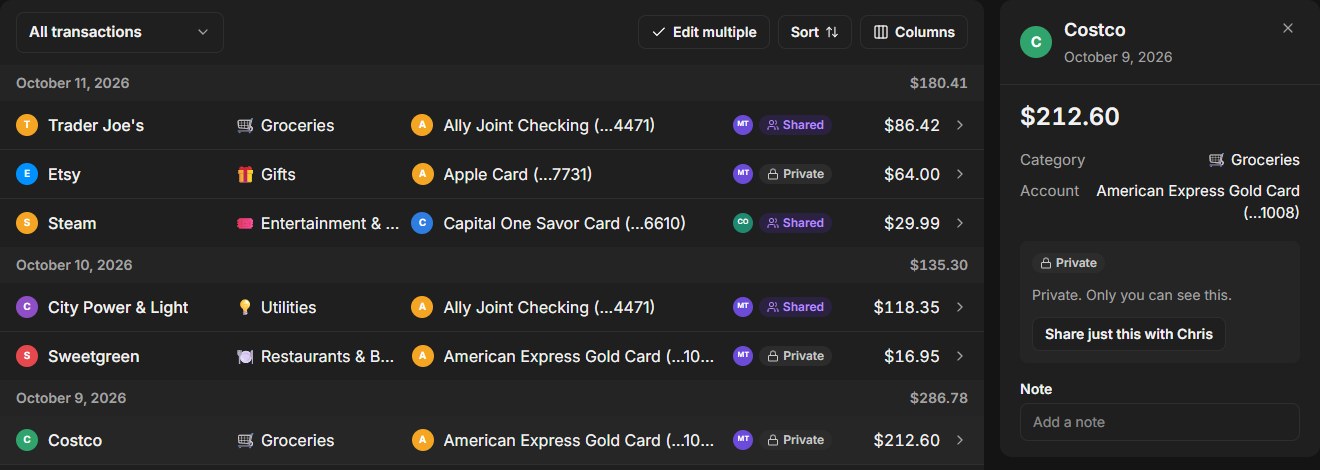
In Monarch's community thread launching the labels (r/MonarchMoney), people asked to keep gift purchases from a partner. Hiding one purchase and sharing one purchase are the same need from opposite sides, for example groceries bought on a personal card. So sharing had to work one transaction at a time, not only per account.
Shared spending breaks personal budgets
In the same thread, people asked for separate budgets when finances are only partly merged, because shared accounts disrupt each person's own budget. That shaped the budget exploration below.
Should Chris know that Maya has private accounts?
Two of my own constraints pulled in opposite directions. "Private must not read as secretive" argued for showing that private accounts exist, maybe with a count or a "balance only" option, so nothing felt hidden. "Nothing private can leak" argued for showing nothing at all. A count looks honest, but it starts the very conversation the feature is meant to spare people: what's in the six accounts I can't see?
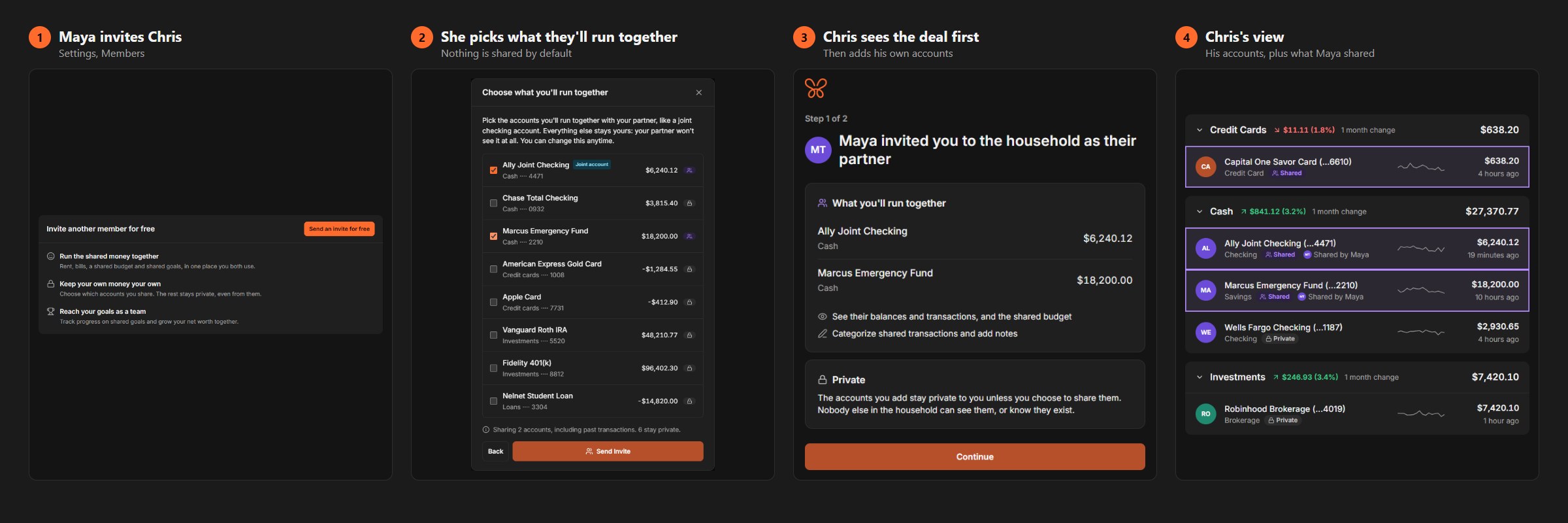
I chose to show nothing, and to earn fairness a different way. The rule is the same for both people and stated up front: before Chris joins, he sees exactly what Maya shares, and that his own accounts get the same privacy. Nobody else can see them, or know they exist. Fairness comes from symmetry and an explicit deal, not from visibility. That's the bet testing has to prove.
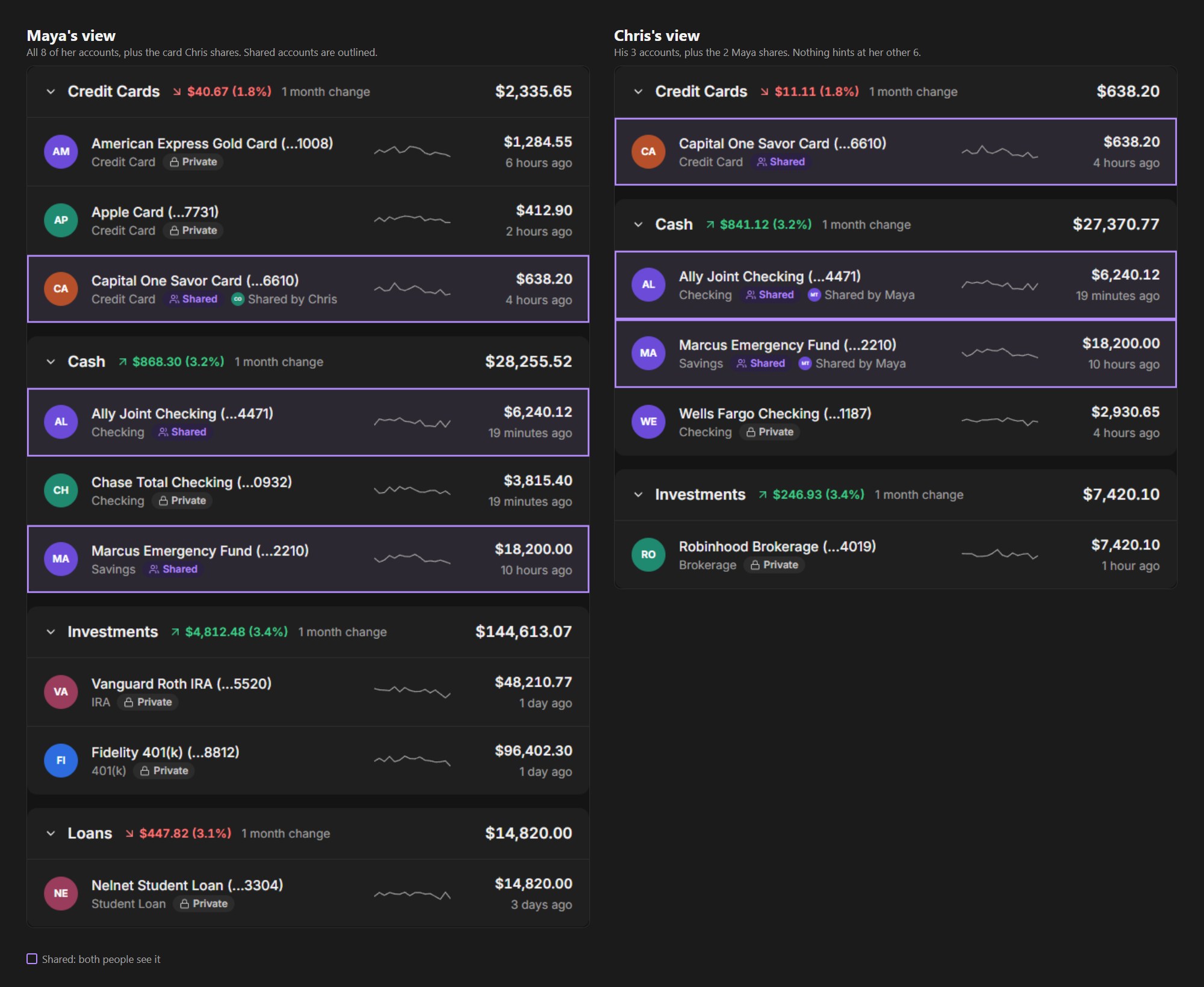
Keeping the shared picture honest is the hard part: every number has to add up for each person without revealing what they can't see. So I audited every page from Chris's side, and the scripted walkthrough now flags any private account named on his screens. The audit changed three things:
A shared transaction names the person, not the card
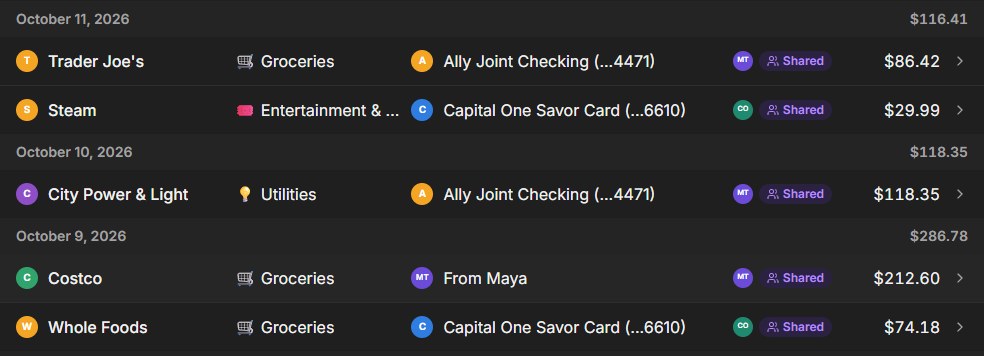
Showing which card a shared purchase came from would reveal a private account. Chris sees "From Maya" instead.
Totals count only what you can see
"Available for goals" includes only shared goals, so a private goal can't shrink a shared number.
Fixed contributions, not income splits
Splitting a shared fund by income would reveal each person's income, so contributions are fixed amounts.
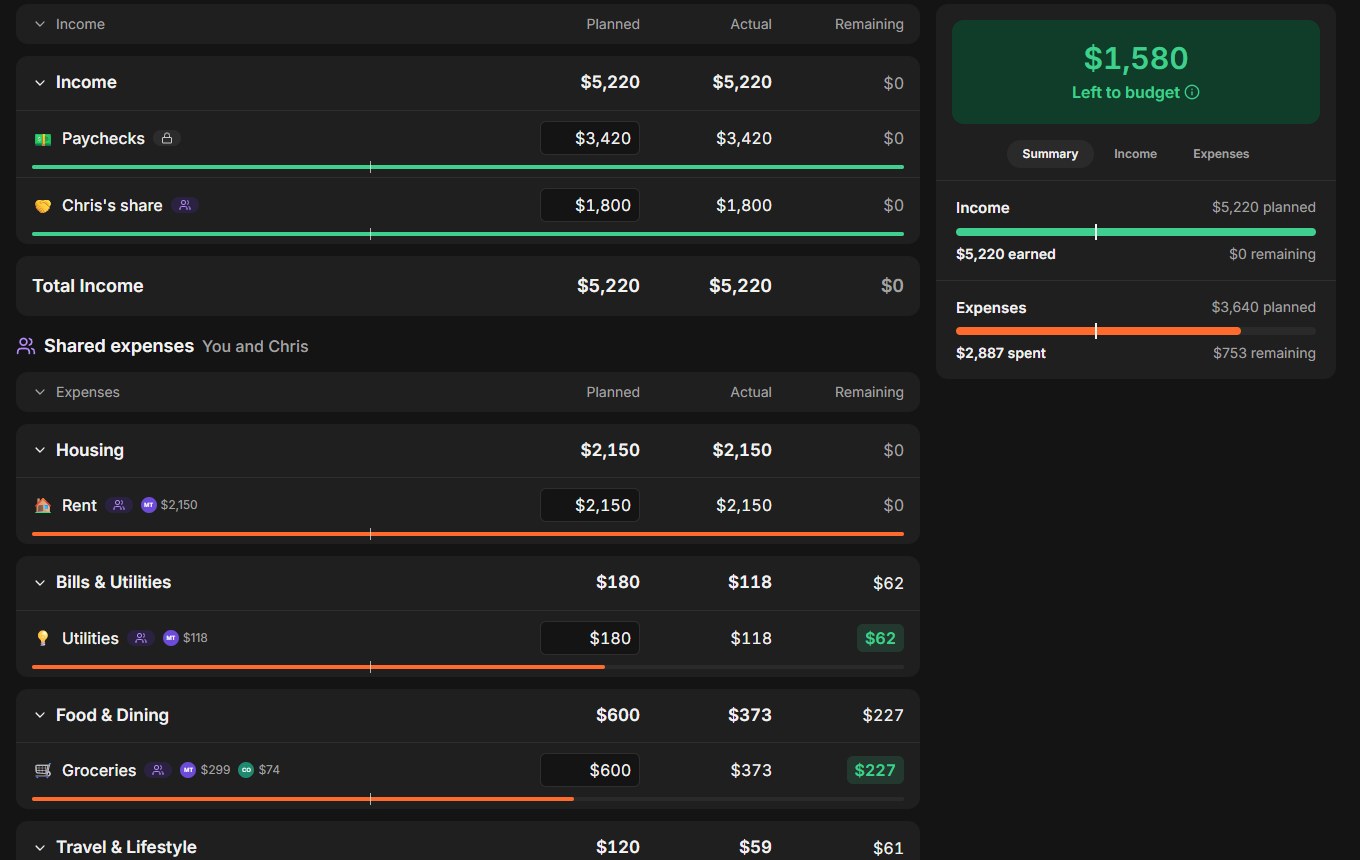
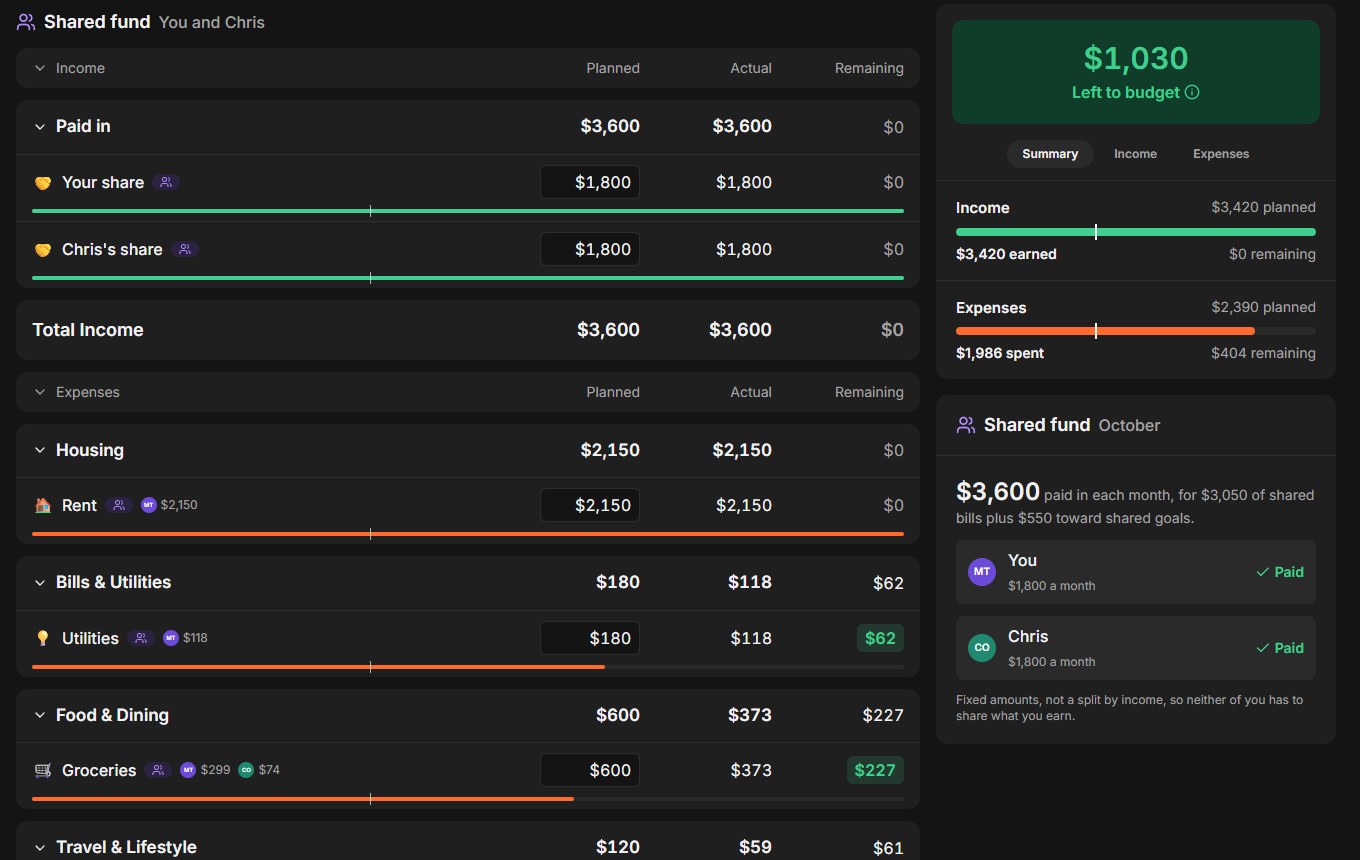
Budgets are where shared and private money collide, and Monarch has no separate budgets today. I built three working designs on Monarch's real Budget page, with the same data and privacy rules: A, one budget split into Shared and Private; B, two separate budgets, like YNAB; and C, a shared fund each person pays into. B is what the thread literally asked for, at twice the setup and upkeep. I chose A: it's the smallest change to a page people already know, and it fixes the cause they named, shared costs disrupting each person's own budget, without a second budget to run. C adds a new concept to Monarch, and its fair split would reveal each person's income. Choosing A over what people asked for is a bet, so the Run it together test checks it.
Share what you run together
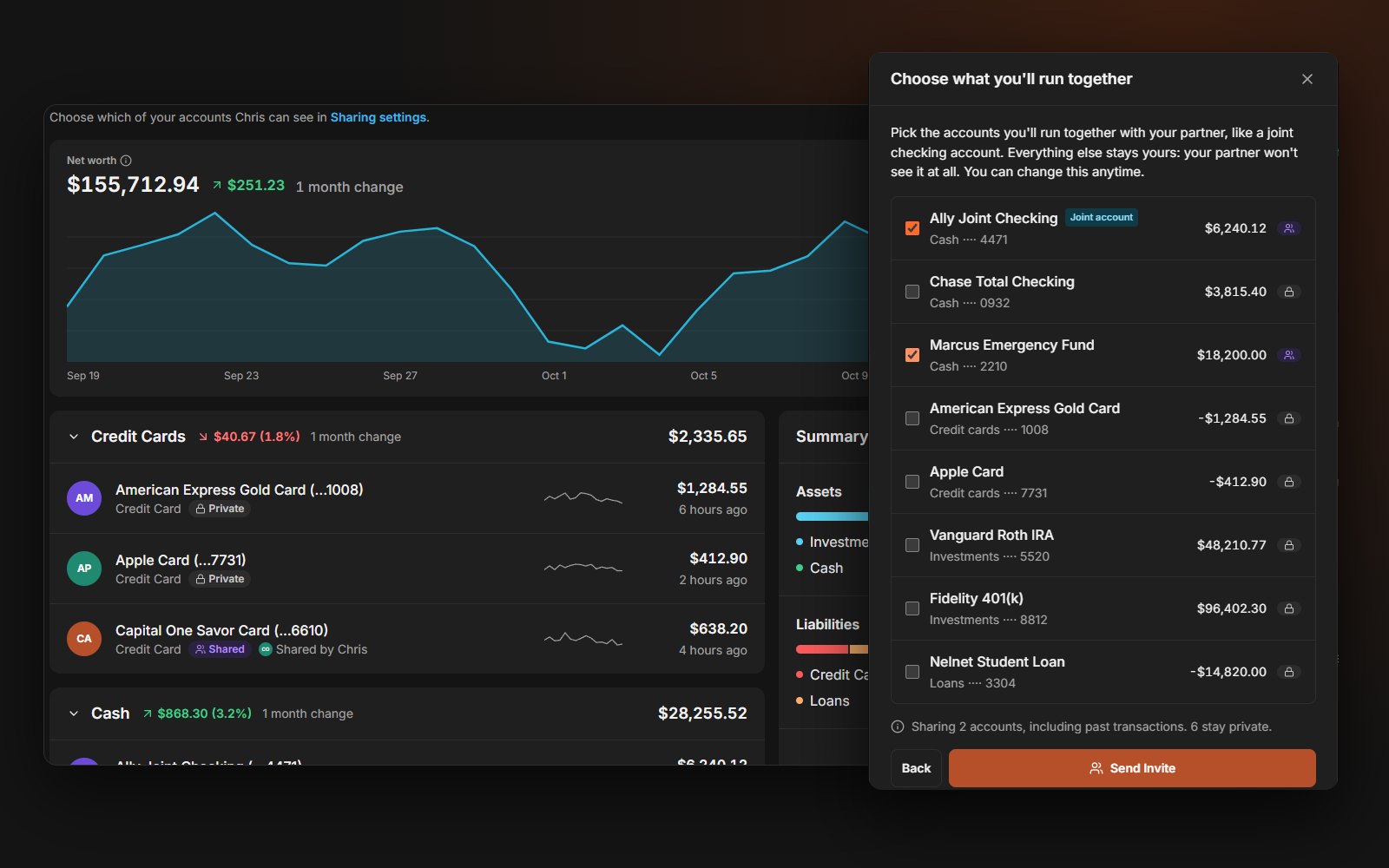
What a household runs together is set where people are already thinking about it: the invite. Nothing is shared by default, and accounts that look joint are marked in the list to help. Afterward, Settings has one Sharing page to change it.
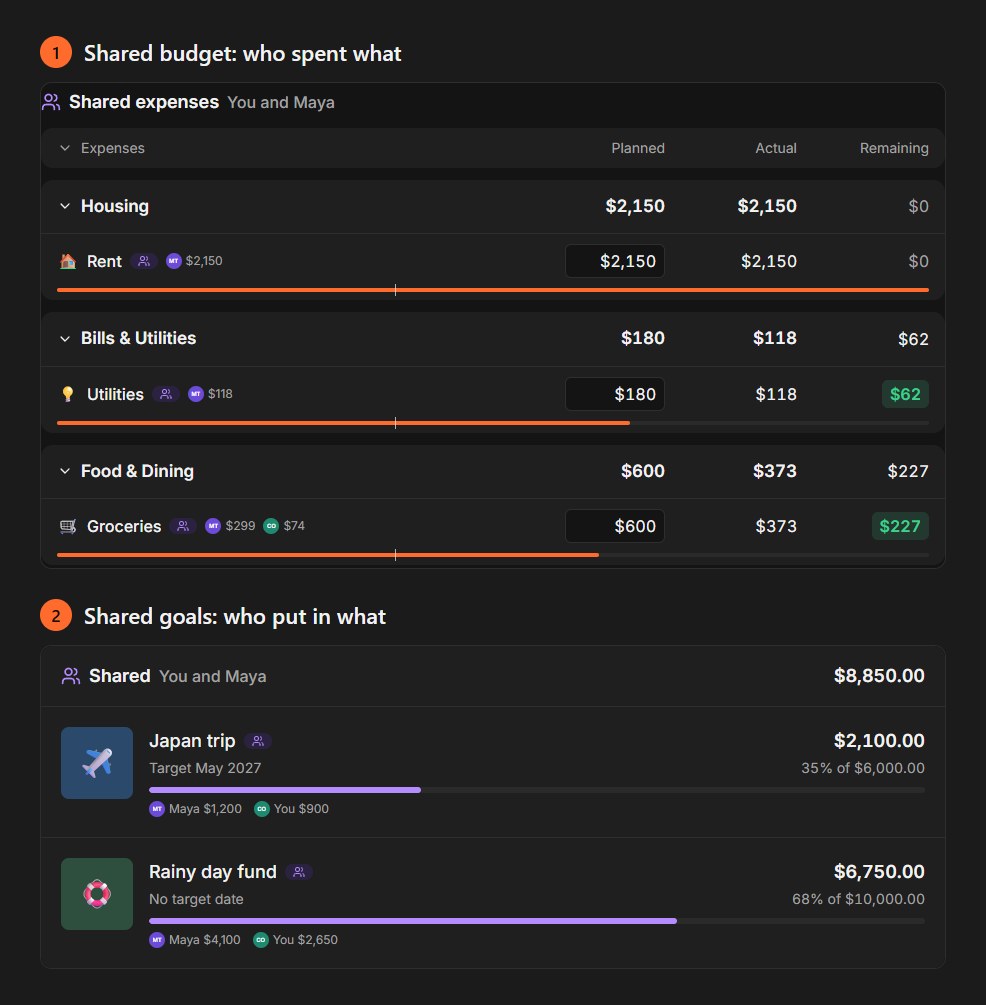
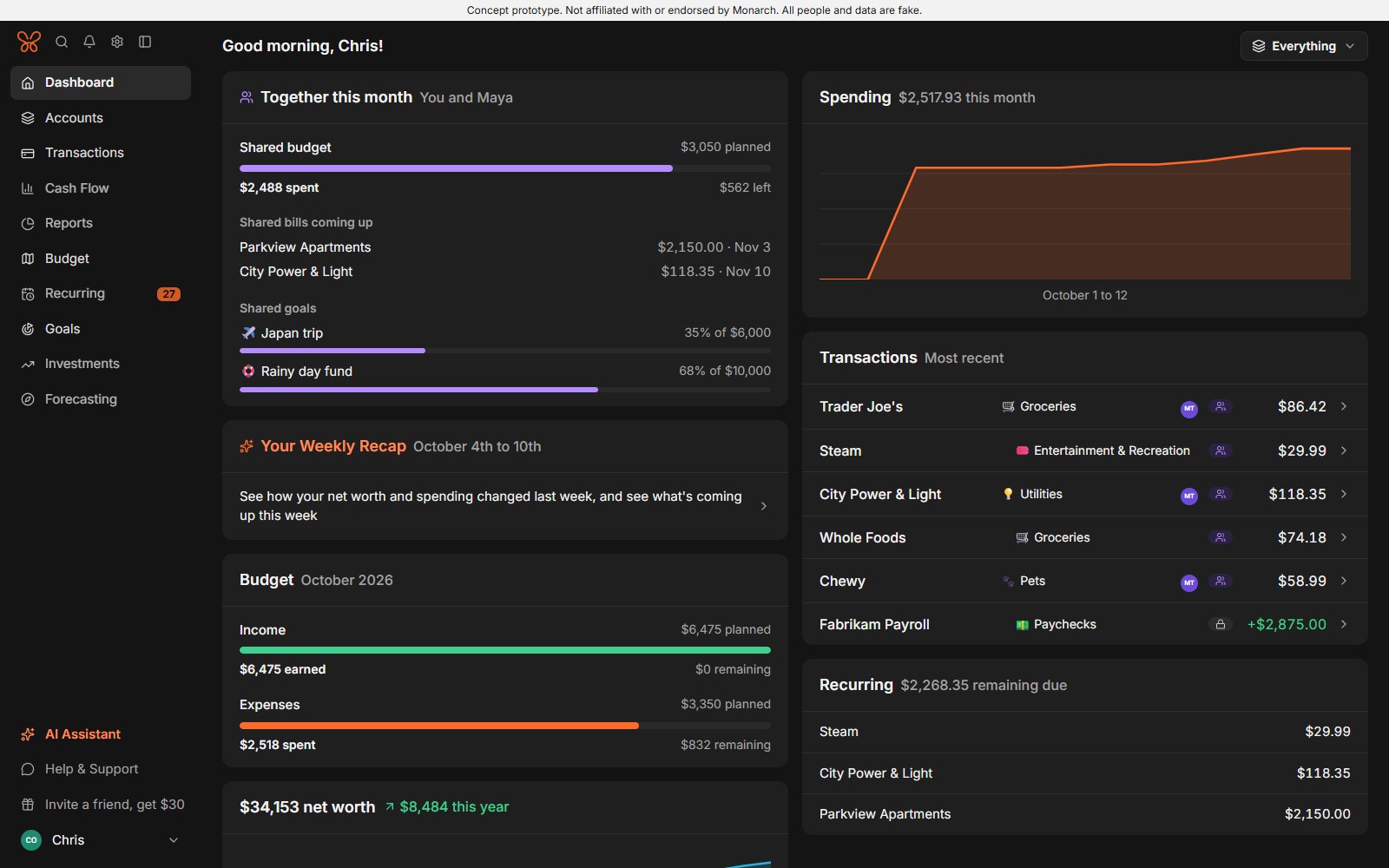
Once the household is set up, both people run the shared money from the pages they already use. The shared budget shows who spent what in each category, so either of them can see where the month stands, and shared goals show what each person has put in. Each still has their own accounts, budget and goals alongside, in the Everything view or on their own in Private.
Shared costs don't always come from the joint account. When Maya buys the groceries on her personal card, she can share just that purchase, so it counts toward the shared budget. Chris sees who it's from, never which card, and nothing else on it.
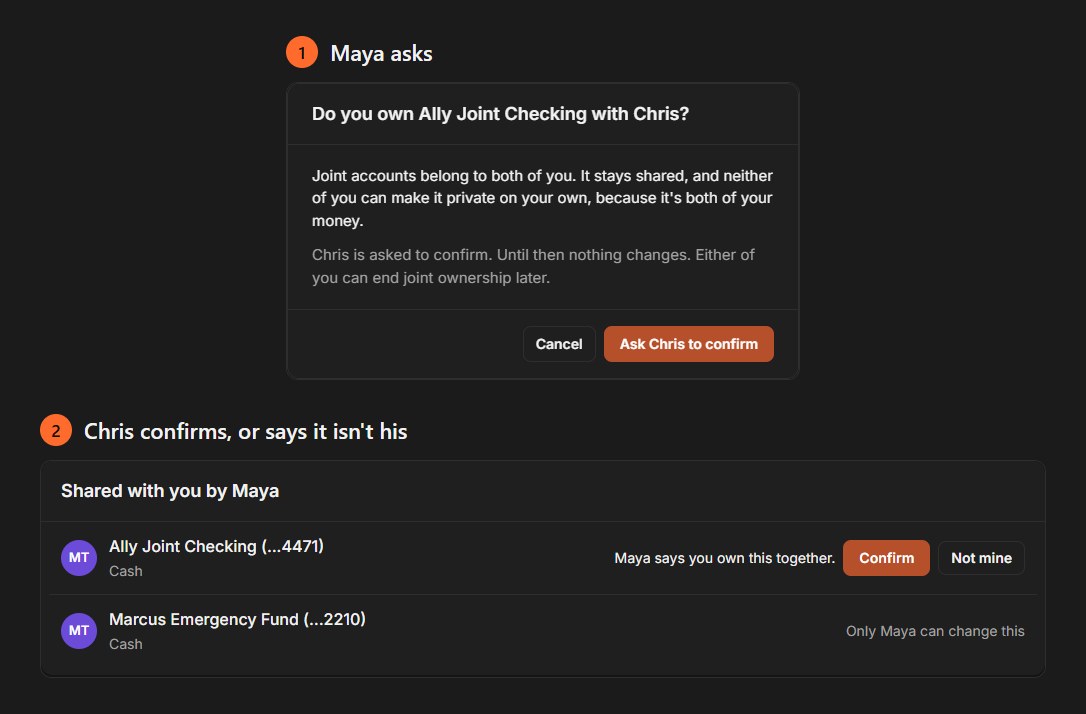
Joint accounts. The money a couple runs together usually sits in a real joint account, owned by both of them. In Monarch it's connected through one person's login, so that person alone could take it out of the shared view. Instead, Maya marks it as joint and Chris confirms. From then on it stays shared, and neither of them can make it private alone. Either can end joint ownership, and the other is told. What lost: leaving it with whoever connected it, which lets one person pull money both of them own out of the shared picture.
There are no results yet, and I won't invent them. Next, five people aged 20 to 30, the age group most likely to keep money separate (Bankrate), who share a home with a partner or roommate will play both sides, Maya inviting and Chris joining. Each measure has a pass mark set before testing, so the result can fail: